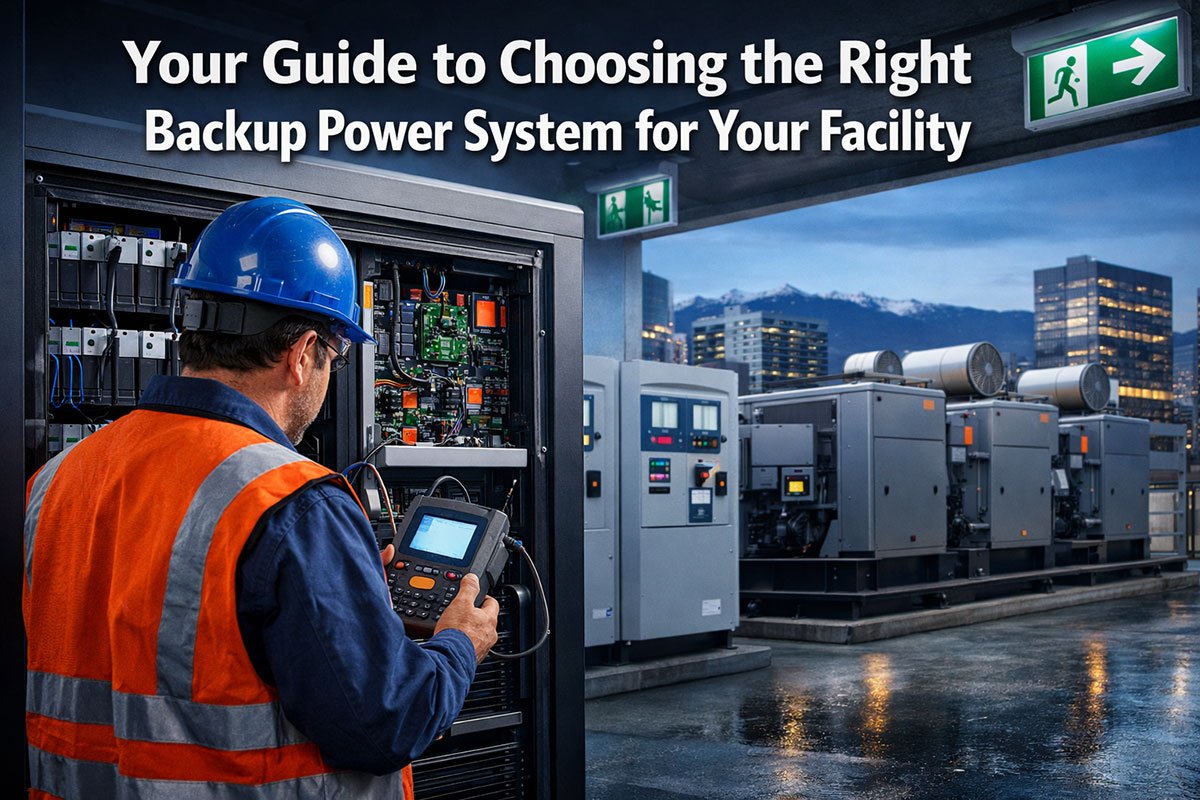

Commercial power systems in Mission BC require careful planning to support building expansions, with most warehouse and office facilities needing 400-1200 amp service upgrades, three-phase distribution, and scalable infrastructure that meets BC Electrical Code requirements. Professional electrical contractors design these systems to handle current loads plus 25-40% future capacity, ensuring businesses avoid costly retrofits as operations grow.
Key Takeaways
- Commercial power systems in Mission BC must comply with BC Electrical Code and accommodate future expansion needs during initial design
- Three-phase power distribution is standard for commercial buildings over 5,000 square feet or with heavy equipment loads
- Service upgrades typically range from 400 to 2000 amps depending on building size, tenant mix, and operational requirements
- Smart electrical monitoring systems reduce energy costs by 15-30% through real-time load tracking and automated controls
- Proper load calculations prevent overloaded circuits, equipment failure, and expensive emergency upgrades
- Panel placement and distribution design directly impact renovation flexibility and tenant improvement costs
- Working with licensed BC electrical contractors ensures code compliance, safety, and utility coordination
- Budgeting for electrical infrastructure should include 20-30% contingency for unforeseen site conditions
What Are Commercial Power Systems and Why Do They Matter for Mission BC Businesses?
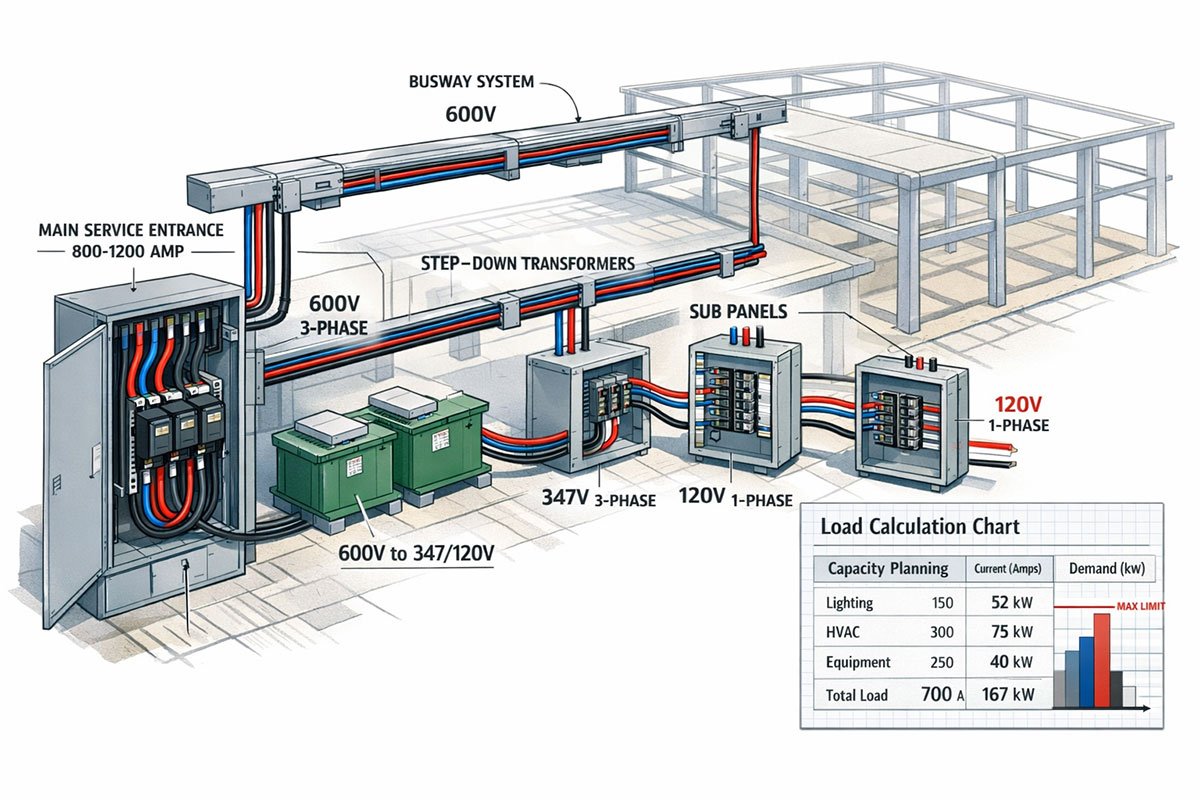
Commercial power systems are the complete electrical infrastructure that delivers, distributes, and manages electricity throughout business facilities, including service entrances, transformers, distribution panels, branch circuits, and monitoring equipment. For Mission BC businesses, these systems must handle diverse loads from office equipment and HVAC to warehouse machinery and specialized manufacturing equipment while meeting provincial safety standards.
Unlike residential electrical systems that typically run on single-phase 120/240V service with 100-200 amp capacity, commercial installations require robust three-phase power distribution. This configuration provides:
- Higher voltage options (347/600V or 120/208V) for efficient motor operation
- Balanced load distribution across three conductors reducing neutral current
- Greater capacity without proportionally larger conductors
- Better power quality for sensitive electronic equipment and variable frequency drives
Mission BC’s growing commercial sector—spanning logistics warehouses, food processing facilities, manufacturing operations, and multi-tenant office buildings—creates unique electrical demands. Buildings that start as simple warehouse shells often evolve into complex operations requiring:
- Refrigeration systems drawing 50-200 amps continuously
- Material handling equipment with high starting currents
- Office areas with dense computer and HVAC loads
- Electric vehicle charging infrastructure
- Backup power systems for critical operations
Common mistake: Many building owners initially install minimal electrical capacity to reduce construction costs, only to discover that tenant improvements or operational changes require complete service upgrades costing $50,000-$200,000 within 3-5 years.
How Do You Determine the Right Electrical Capacity for Expanding Buildings?
Determining electrical capacity starts with a comprehensive load calculation that accounts for current operations plus anticipated growth, typically performed by licensed electrical engineers or contractors familiar with BC building codes. The calculation considers connected loads, demand factors, and future expansion zones to establish service size requirements.
Step-by-step capacity planning process:
- Inventory existing loads – Document all current electrical equipment with nameplate ratings, operating hours, and usage patterns
- Apply demand factors – Use BC Electrical Code tables to calculate realistic simultaneous demand (not all equipment runs at full capacity simultaneously)
- Add expansion allowance – Include 25-40% additional capacity for future equipment, tenant improvements, or operational changes
- Calculate voltage drop – Ensure adequate conductor sizing for building dimensions and load locations
- Determine service configuration – Select appropriate voltage system (120/208V or 347/600V) based on predominant loads
- Coordinate with utility – Confirm BC Hydro service availability and transformer requirements for the site
Typical commercial capacity ranges:
| Building Type | Square Footage | Typical Service Size | Key Considerations |
|---|---|---|---|
| Light office/retail | 5,000-15,000 | 400-600 amps | HVAC, lighting, office equipment |
| Warehouse/distribution | 15,000-50,000 | 600-1200 amps | Dock equipment, material handling, office areas |
| Manufacturing/processing | 20,000-100,000 | 1200-2000+ amps | Heavy machinery, process equipment, compressed air |
| Multi-tenant commercial | 10,000-40,000 | 800-1600 amps | Diverse tenant mix, flexibility for improvements |
Choose three-phase service if: Your facility has motors over 5 HP, requires more than 400 amps total capacity, includes HVAC systems over 10 tons, or needs balanced power distribution across multiple zones.
Edge case: Food processing and cold storage facilities in Mission BC often require significantly higher capacity (150-200 watts per square foot) compared to standard warehouses (20-40 watts per square foot) due to refrigeration compressors and process equipment.
What Infrastructure Components Make Up Modern Commercial Power Systems in Mission BC?
Modern commercial power systems consist of interconnected components that safely deliver electricity from the utility connection point to every outlet and device throughout the facility. The system architecture determines reliability, flexibility, and future expansion capabilities.
Core infrastructure components:
Service entrance equipment – The main disconnect and metering point where BC Hydro’s supply connects to the building. This includes weatherproof enclosures, main circuit breakers or fused disconnects rated for total building capacity, and utility metering equipment. Mission BC installations typically use outdoor-rated gear suitable for coastal climate conditions.
Transformers – Step-down voltage from utility levels (typically 12kV or 25kV distribution) to usable building voltages. Pad-mounted transformers serve larger facilities, while smaller buildings may receive transformed power directly from BC Hydro’s distribution system.
Main distribution panels – Heavy-duty panelboards or switchboards that receive power from the service entrance and distribute it to sub-panels throughout the building. These include main overcurrent protection, ground fault protection, and bus bars rated for full service capacity.
Sub-panels and branch circuits – Secondary distribution points located throughout the building that serve specific areas or tenant spaces. Proper sub-panel placement reduces voltage drop and provides convenient circuit access for modifications.
Emergency and standby power – Automatic transfer switches, backup generators, or uninterruptible power supplies (UPS) that maintain critical operations during utility outages. BC Electrical Code requires emergency systems for life safety equipment like exit lighting and fire alarms.
Monitoring and control systems – Smart metering, power quality analyzers, and building management integration that track energy consumption, identify inefficiencies, and enable remote monitoring.
Grounding and bonding systems – Safety infrastructure that provides low-resistance paths to earth, protecting personnel from electrical faults and ensuring proper equipment operation.
Decision rule: Install sub-panels in each major building zone (typically every 5,000-10,000 square feet) rather than running all circuits from a central location. This approach reduces copper costs, minimizes voltage drop, and simplifies future modifications.
How Should Growing Businesses Plan Commercial Power Systems in Mission BC?
Growing businesses should plan commercial power systems by designing for ultimate capacity from day one, even if initial installation only includes partial infrastructure, because adding service capacity later requires utility coordination, permit processes, and operational disruptions that cost 2-3 times more than upfront planning. The strategy involves installing oversized conduits, panel spaces, and service equipment while initially connecting only the circuits needed for current operations.
Practical planning approach:
Phase 1 – Initial installation: Install full-capacity service entrance equipment, main panels, and distribution infrastructure. Connect only the sub-panels and circuits needed for current operations. This approach costs 15-25% more initially but eliminates future service upgrades.
Phase 2 – Incremental expansion: As operations grow, add sub-panels and branch circuits using pre-installed conduit pathways and spare panel capacity. These additions require only electrical contractor time, not utility coordination or major construction.
Phase 3 – Technology integration: Incorporate smart monitoring, automated controls, and energy management systems that optimize consumption as the facility matures.
Critical planning elements:
- Conduit sizing – Install 1.5-2x the conduit size currently needed to allow future conductor upgrades without demolition
- Panel space allocation – Specify panels with 30-40% spare circuit positions for future additions
- Floor space reservation – Designate and protect electrical room areas sized for ultimate equipment needs
- Documentation – Maintain accurate as-built drawings showing conduit routes, panel schedules, and spare capacity
Common mistake: Installing panels in locations convenient for initial construction but inaccessible once operations begin. Electrical rooms should have clear access, adequate working clearances (minimum 3.5 feet in front of panels per BC Electrical Code), and protection from forklifts, storage, and other obstructions.
For Mission BC specifically: Coordinate early with BC Hydro for service availability confirmation. Some industrial areas have limited transformer capacity, and utility upgrades can add 6-12 months to project timelines if not addressed during initial planning.
What Are the Benefits of Smart Electrical Systems for Commercial Buildings?
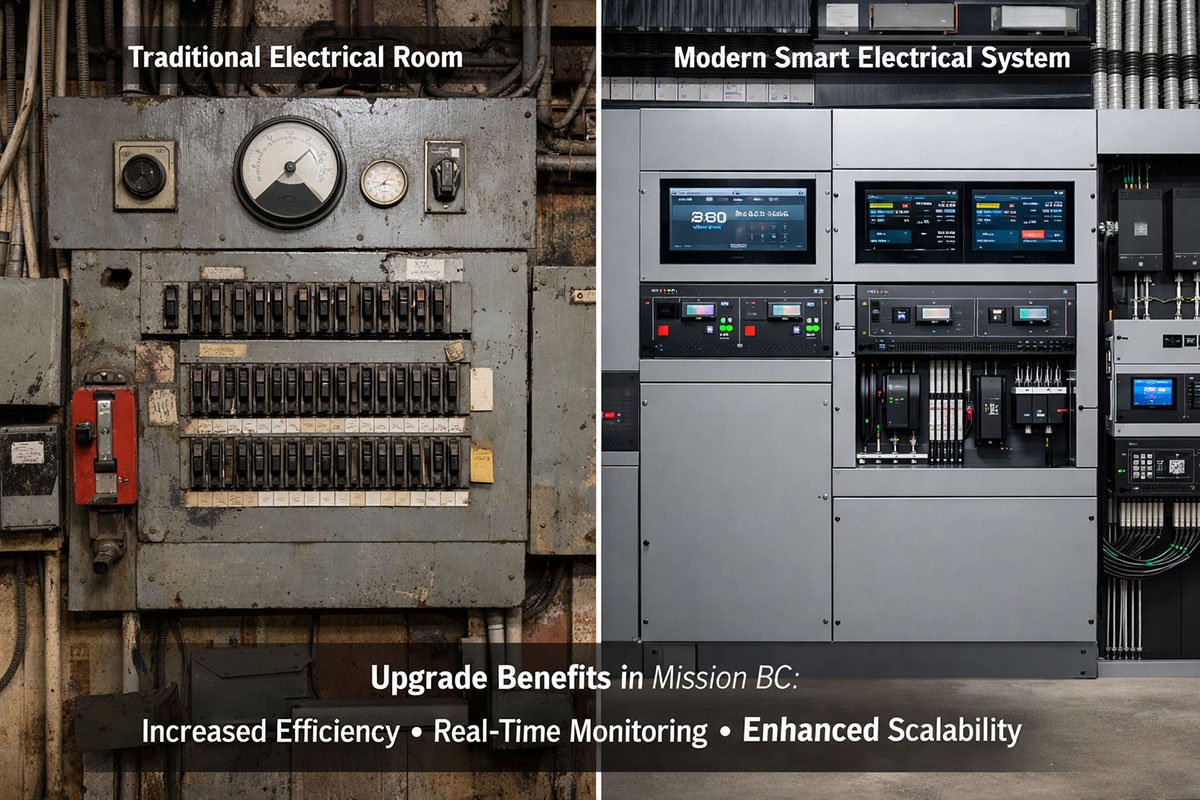
Smart electrical systems provide real-time monitoring, automated control, and data analytics that reduce energy costs by 15-30%, prevent equipment failures through predictive maintenance, and enable remote management of building operations. These systems integrate digital meters, sensors, and controllers with cloud-based platforms that give facility managers unprecedented visibility into electrical consumption and performance.
Key benefits:
Energy cost reduction – Smart systems identify waste, optimize schedules, and automatically adjust loads during peak-rate periods. Commercial buildings in Mission BC typically see $5,000-$25,000 annual savings depending on facility size and rate structure.
Predictive maintenance – Continuous monitoring detects abnormal current draw, power quality issues, and equipment degradation before failures occur. This prevents costly emergency repairs and production downtime.
Load management – Automated demand response systems shed non-critical loads during peak periods, reducing demand charges that can represent 30-50% of commercial electricity bills.
Tenant sub-metering – Multi-tenant buildings can accurately allocate electricity costs to individual tenants based on actual consumption rather than estimated square footage calculations.
Remote diagnostics – Facility managers can monitor multiple locations, receive alerts for abnormal conditions, and troubleshoot issues without site visits.
Compliance documentation – Automated reporting provides energy consumption data required for building certifications, carbon reduction programs, and regulatory compliance.
Implementation considerations:
Choose systems that integrate with existing building automation platforms rather than standalone solutions. Open protocols like BACnet and Modbus ensure compatibility with HVAC, lighting, and security systems.
Budget $3,000-$8,000 per monitored panel for smart metering equipment and installation, plus $500-$2,000 annually for cloud platform subscriptions and data services.
Edge case: Buildings with highly variable operations (seasonal production, shift work, or event-based activity) see the greatest benefit from smart systems because automated scheduling and load profiling capture savings that manual management misses.
What Code Requirements and Permits Apply to Commercial Power Systems in Mission BC?
Commercial power systems in Mission BC must comply with the BC Electrical Code (based on the Canadian Electrical Code with provincial amendments), obtain electrical permits from the local authority having jurisdiction, and pass inspections by Technical Safety BC before energization. All work must be performed by licensed electrical contractors holding valid BC trade certifications.
Regulatory framework:
BC Electrical Code – Establishes minimum safety standards for electrical installations, covering conductor sizing, overcurrent protection, grounding, working clearances, and equipment ratings. The code updates every three years, with the current edition incorporating energy efficiency and safety improvements.
Technical Safety BC – Provincial regulatory body that licenses electrical contractors, issues permits, conducts inspections, and enforces compliance. All commercial electrical work requires notification and inspection regardless of project size.
Local building permits – Mission BC municipal requirements may include additional inspections, development permits, or coordination with other building systems. Check with the District of Mission planning department for specific requirements.
BC Hydro coordination – Utility service upgrades require applications, engineering reviews, and construction agreements. Plan for 8-16 week timelines for service increases over 600 amps.
Key compliance requirements:
- Working clearances: Minimum 3.5 feet in front of panels, 30 inches width, full panel height
- Ground fault protection: Required for services over 150 volts to ground
- Arc fault protection: Required in specific applications per code updates
- Emergency lighting: Battery backup for egress paths and exit signs
- Bonding and grounding: Proper electrode systems and equipment grounding conductors
- Labeling: Clear identification of circuits, voltages, and disconnects
Permit process timeline:
- Submit plans and load calculations (1-2 weeks for review)
- Receive permit and begin installation (varies by project scope)
- Request rough-in inspection (before covering work)
- Complete installation and request final inspection
- Receive approval and energize system
Common mistake: Starting electrical work before permit approval or failing to request required inspections. Technical Safety BC can issue stop-work orders and require complete reinstallation for unpermitted work, regardless of quality.
How Do You Choose the Right Electrical Contractor for Commercial Power Systems in Mission BC?
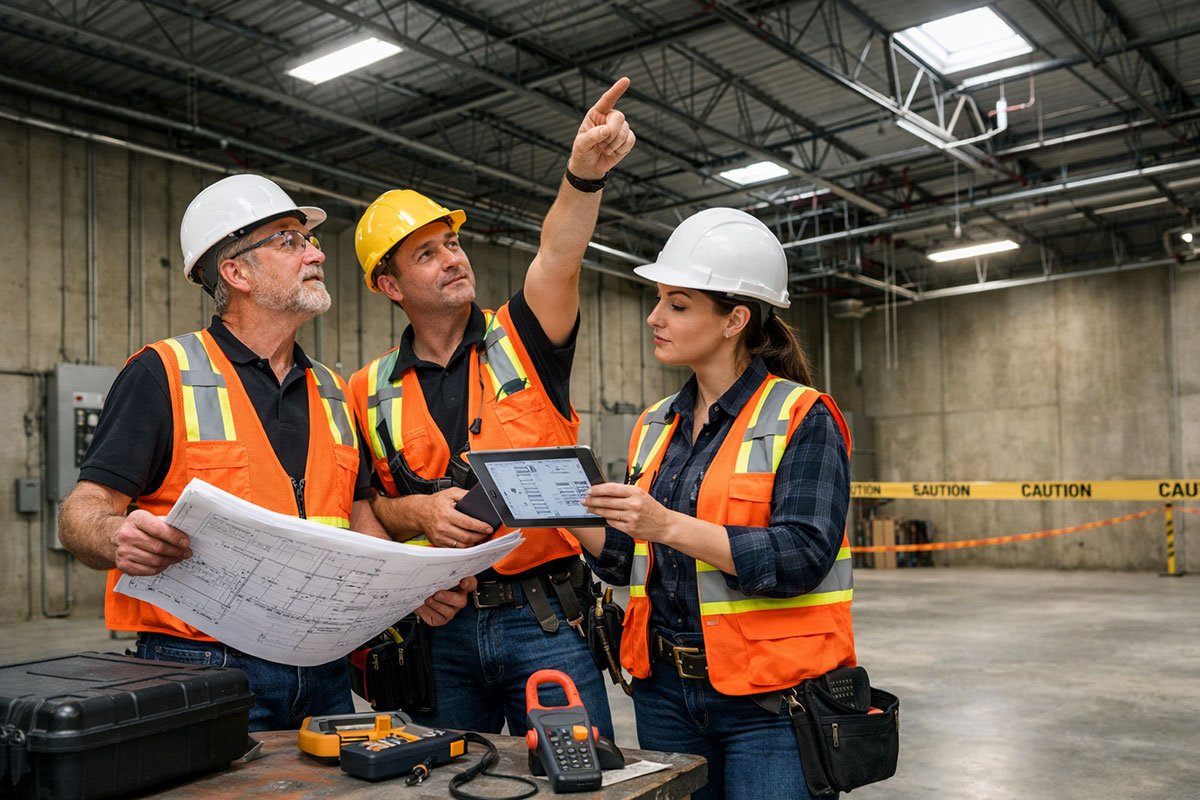
Choose electrical contractors who hold valid BC electrical contractor licenses, carry appropriate insurance coverage ($2-5 million commercial general liability), demonstrate experience with similar commercial projects in the region, and provide detailed written proposals with clear scope definitions and fixed pricing. Verify licensing through Technical Safety BC’s online registry and request references from recent commercial clients.
Contractor evaluation criteria:
Licensing and credentials:
- Valid BC electrical contractor license (not just individual electrician certification)
- Workers’ compensation coverage in good standing
- Commercial general liability insurance with adequate limits
- Bonding capacity for larger projects
Experience and expertise:
- Portfolio of similar commercial projects (size, complexity, building type)
- Familiarity with BC Electrical Code and local requirements
- Established relationships with BC Hydro and Technical Safety BC
- In-house engineering capabilities or engineering partnerships
Business practices:
- Detailed written proposals with scope, exclusions, and allowances clearly defined
- Transparent pricing structure (fixed price, time and materials, or unit pricing)
- Project timeline with milestones and completion dates
- Warranty terms for workmanship and materials
Red flags to avoid:
- Reluctance to provide proof of licensing or insurance
- Verbal estimates without written documentation
- Significantly lower pricing than other qualified bidders (often indicates scope gaps)
- Pressure to start work before permits are secured
- Limited or no references from commercial clients
Questions to ask prospective contractors:
- What is your experience with [specific building type] electrical systems in Mission BC?
- How do you handle permit applications and inspection coordination?
- What is your typical project timeline for this scope of work?
- How do you manage changes or unforeseen conditions during installation?
- What warranty do you provide on workmanship and equipment?
- Who will be the primary point of contact and project supervisor?
Decision rule: Select contractors based on qualifications and value rather than lowest price alone. A $10,000 difference in initial cost is negligible compared to the long-term impact of poor design, code violations, or reliability issues.
What Are Common Mistakes When Upgrading Commercial Power Systems?
The most common mistake when upgrading commercial power systems is underestimating future capacity needs and installing the minimum service required for current operations, forcing expensive secondary upgrades within 3-5 years as businesses grow or tenants change. This error stems from focusing on immediate construction budgets rather than lifecycle costs and operational flexibility.
Critical mistakes to avoid:
Inadequate capacity planning – Installing 400-amp service when operations clearly trend toward requiring 600-800 amps. The cost difference for larger service during initial construction is $15,000-$30,000, but retrofitting later costs $60,000-$120,000 plus business disruption.
Poor panel placement – Locating electrical rooms in areas that become inaccessible, too small for equipment, or lack proper working clearances once operations begin. BC Electrical Code violations for inadequate clearances require expensive relocations.
Ignoring voltage drop – Undersizing conductors or running excessive distances from panels to loads causes voltage drop that damages motors, overheats equipment, and wastes energy. Proper conductor sizing costs 10-20% more initially but prevents these ongoing problems.
Skipping monitoring systems – Foregoing energy monitoring to save $10,000-$20,000 eliminates the ability to identify waste, verify utility billing accuracy, or make data-driven operational decisions. The monitoring investment typically pays back within 2-3 years through identified savings.
Inadequate documentation – Failing to maintain accurate as-built drawings, panel schedules, and equipment specifications makes future modifications difficult, time-consuming, and prone to errors. Documentation should be updated with every change.
Mixing electrical and storage – Using electrical rooms for general storage, blocking panel access, or storing combustible materials near electrical equipment. This creates code violations and safety hazards.
Delaying necessary upgrades – Operating with overloaded circuits, frequent breaker trips, or undersized equipment because “it’s worked so far.” Electrical failures cause production losses, equipment damage, and fire risks far exceeding upgrade costs.
Value engineering critical infrastructure – Cutting electrical budget to meet overall project costs by reducing panel capacity, eliminating spare circuits, or downsizing conductors. These decisions have the highest long-term cost impact of any construction trade.
Edge case: Facilities planning future rooftop solar installations must include appropriately sized conduit pathways and panel capacity during initial construction. Adding these later requires expensive roof penetrations and panel replacements.
How Much Do Commercial Power System Upgrades Cost in Mission BC?
Commercial power system upgrades in Mission BC typically cost between $40,000 and $250,000 depending on service size, building configuration, and site conditions, with most warehouse and office facilities spending $75,000-$150,000 for complete 800-1200 amp service installations including utility coordination, main panels, distribution infrastructure, and permit fees. Costs break down into utility charges (20-30%), electrical contractor labor and materials (50-60%), permits and engineering (10-15%), and contingency for unforeseen conditions (10-15%).
Cost breakdown by component:
Utility service upgrades:
- BC Hydro service connection fee: $8,000-$25,000
- Transformer installation (if required): $15,000-$40,000
- Trench and conduit to building: $5,000-$15,000
Electrical contractor scope:
- Main service entrance equipment: $12,000-$35,000
- Main distribution panel: $8,000-$25,000
- Sub-panels (per panel): $2,500-$6,000
- Conduit and conductor installation: $15,000-$60,000
- Labor and project management: $25,000-$80,000
Engineering and permits:
- Electrical engineering design: $5,000-$15,000
- Permit fees: $1,500-$5,000
- Inspection coordination: included in contractor scope
Cost factors that increase pricing:
- Distance from utility connection point to building
- Underground obstacles requiring directional boring
- Existing building occupied during upgrade (requires phased work)
- Specialized equipment for specific industries
- Seismic or environmental conditions requiring additional measures
- Tight timelines requiring overtime or expedited utility coordination
Cost-saving strategies:
Schedule utility coordination during planning phases rather than as construction begins. BC Hydro service upgrades have fixed timelines that can’t be expedited, so early engagement prevents project delays.
Bundle electrical upgrades with other building improvements to share mobilization costs, permit fees, and site disruption.
Install full-capacity infrastructure initially even if only partial circuits are connected. Adding circuits later costs $50-$150 per circuit versus complete service upgrades at $50,000-$150,000.
Financing options: Many electrical contractors offer payment terms for larger projects, or businesses can explore equipment financing, commercial construction loans, or BC Hydro’s Power Smart incentive programs that provide rebates for energy-efficient upgrades.
Conclusion
Modern commercial power systems form the foundation for business growth and operational reliability in Mission BC’s expanding commercial sector. Proper electrical infrastructure planning—incorporating adequate capacity, smart monitoring technology, and code-compliant installation—prevents costly retrofits while enabling businesses to adapt to changing operational needs. The difference between reactive electrical upgrades and proactive system design is measured not just in dollars but in avoided downtime, operational flexibility, and long-term business resilience.
Actionable next steps for commercial building owners:
- Conduct a capacity assessment – Engage a licensed electrical contractor to evaluate current electrical infrastructure against anticipated 5-10 year operational needs
- Document existing systems – Create or update as-built electrical drawings, panel schedules, and load calculations for future planning reference
- Prioritize upgrades – Identify critical deficiencies (overloaded circuits, code violations, inadequate capacity) requiring immediate attention versus longer-term improvements
- Budget appropriately – Allocate 8-12% of building value for electrical infrastructure in expansion projects, with additional contingency for older facilities
- Engage early with utilities – Contact BC Hydro 6-12 months before anticipated service upgrades to understand availability, costs, and timelines
- Select qualified contractors – Verify licensing, insurance, and commercial experience before soliciting proposals for electrical work
- Implement monitoring – Install energy monitoring systems to establish baseline consumption and identify optimization opportunities
The investment in properly designed commercial power systems in Mission BC pays dividends through reduced operating costs, improved reliability, and the flexibility to pursue business opportunities without electrical infrastructure constraints. As commercial buildings evolve and expand, the electrical systems that support them must be equally adaptable—a goal achieved through thoughtful planning, quality installation, and ongoing maintenance by qualified professionals.
Frequently Asked Questions
How long does a commercial electrical service upgrade take in Mission BC?
Commercial electrical service upgrades typically require 8-16 weeks from initial planning to final energization, including 4-8 weeks for BC Hydro coordination, 2-3 weeks for permit approval, 3-6 weeks for installation, and 1-2 weeks for inspection and commissioning. Occupied buildings may require longer timelines to phase work around operations.
Can I upgrade electrical service without disrupting business operations?
Yes, most commercial electrical upgrades can be performed with minimal disruption by installing new service equipment in parallel with existing systems, then switching over during a planned brief outage (typically 4-8 hours). Discuss phasing requirements with your electrical contractor during planning to minimize operational impact.
What size electrical service does a 20,000 square foot warehouse need?
A 20,000 square foot warehouse typically requires 600-1000 amp service depending on operational intensity, with light storage operations at the lower end and manufacturing or cold storage at the higher end. Proper sizing requires detailed load calculations based on actual equipment and future expansion plans.
How often should commercial electrical systems be inspected?
Commercial electrical systems should receive professional inspections every 3-5 years for general facilities, or annually for high-demand operations with critical equipment. Additional inspections are warranted after major equipment additions, operational changes, or any electrical problems like frequent breaker trips.
Do I need three-phase power for my commercial building?
You need three-phase power if your facility has motors over 5 HP, requires more than 400 amps total capacity, includes HVAC systems over 10 tons, or needs to distribute loads across multiple building zones. Most commercial buildings over 10,000 square feet benefit from three-phase service.
What permits are required for commercial electrical work in Mission BC?
All commercial electrical work in Mission BC requires an electrical permit from Technical Safety BC, obtained by your licensed electrical contractor. Projects may also require building permits from the District of Mission depending on scope, and BC Hydro applications for service upgrades.
How much does it cost to add a sub-panel in a commercial building?
Adding a sub-panel in a commercial building costs $2,500-$6,000 including materials, labor, and connection to existing distribution systems. Costs increase if new conduit runs are required from the main panel or if the main panel lacks capacity for additional circuits.
Can I install my own electrical equipment in a commercial building?
No, all commercial electrical work in BC must be performed by licensed electrical contractors and inspected by Technical Safety BC. Building owners cannot legally perform their own electrical installations regardless of experience or qualifications.
What is the lifespan of commercial electrical equipment?
Commercial electrical equipment typically lasts 25-40 years for panels and distribution gear, 15-25 years for circuit breakers and switches, and 30-50 years for properly installed conductors. Regular maintenance, proper loading, and quality installation extend equipment life significantly.
How do I know if my electrical system needs upgrading?
Signs your electrical system needs upgrading include frequent breaker trips, dimming lights when equipment starts, inability to add new circuits, visible corrosion or damage to equipment, outdated panels lacking modern safety features, or operational expansion plans that exceed current capacity.
What incentives are available for commercial electrical upgrades in BC?
BC Hydro offers Power Smart incentive programs providing rebates for energy-efficient lighting, motors, HVAC systems, and building controls. Specific incentives vary by program year and equipment type, so consult BC Hydro’s commercial programs or your electrical contractor for current offerings.
Should I include backup power in my commercial electrical system?
Include backup power if your operations involve perishable inventory, critical manufacturing processes, data systems requiring continuous operation, or life safety systems beyond basic emergency lighting. Backup power systems range from small UPS units ($2,000-$10,000) to whole-building generators ($30,000-$150,000+).